
Auglaize Parole and Probation Compared
The everyday word “probation” can hide several different legal statuses. In Ohio, community control is the court-ordered sanction formerly called probation. Parole is a discretionary release available for some parole-era or life sentences. Post-release control follows certain stated prison terms. These paths can put a person in the community, yet the authority and record are not the same.
A state record marked APA Supervision confirms release from prison into Ohio Adult Parole Authority supervision. It does not show that all obligations are complete. A local community-control case begins with the Auglaize County court docket and Adult Probation Office. The distinctions matter when names match or a person was sentenced in one county but now lives in another.
| Status | Who imposes it | Best verification path |
|---|---|---|
| Parole | Ohio parole process for an eligible prison sentence | ODRC record, hearing result, and APA office |
| Post-release control | Follows a qualifying Ohio prison term | ODRC APA Supervision status and local office |
| Community control | Sentencing court instead of, or after, confinement as ordered | Auglaize CourtView and Adult Probation |
Verify Auglaize Post-Release Supervision
Start with the sentence source, not the live county jail roster. Someone released from the Auglaize County Correctional Center may have community control, may have completed the local case, or may have transferred into state custody. The county archive can document the jail release timestamp. It cannot by itself establish the later supervision type.
- Search the ODRC Offender Search by name or offender number.
- Use the APA Supervision status filter. For a person thought to live locally, add Residential County=Auglaize, but allow for address lag.
- Open the matching record. Compare identifiers, then review supervision start, supervision period, and the listed APA office.
- If the case is court community control, search the applicable Auglaize CourtView docket and contact Adult Probation for public status or office routing.
- When the sources differ, ask the office that owns the record to confirm the current status.
ODRC also offers County of Commitment=Auglaize. That field means the sentencing county, not the person’s current home. If more than one county appears, ODRC says the first listed county is queried. Minimal search criteria can work better than a stack of filters. For court supervision, use Auglaize County’s official Common Pleas CourtView for felony cases or Municipal CourtView for misdemeanor and traffic cases. The broader Auglaize County released-inmate search path explains how the jail archive and court record fit beside the state result.
Auglaize Supervision Office Contacts
Auglaize County Adult Probation is a direct local route. Its published scope is broader than community-control cases alone. The office works with Ohio APA and reports supervising parole, post-release control, interstate residents, and people from other Ohio counties who live in Auglaize County. Staff may confirm routing or public status, but disclosure limits still apply.
Auglaize County Adult Probation
Address: 201 Willipie Street, Suite 106, Wapakoneta, OH
Phone: 419-739-6760
Fax: 419-739-6761
Hours: 8:00 a.m. to 4:30 p.m.; a noon-to-1 lunch closure may apply
After hours: Sheriff dispatch, 419-739-6565
Before calling, have the full name and case or offender number if known. Ask which office owns the supervision record and what public source can confirm it. Do not ask for a presentence investigation report. Auglaize County states that those reports are confidential to offenders, courts, and authorized users, not public records.
The official Adult Probation page shows this same contact path and scope. The screenshot below preserves the office context from that county source.
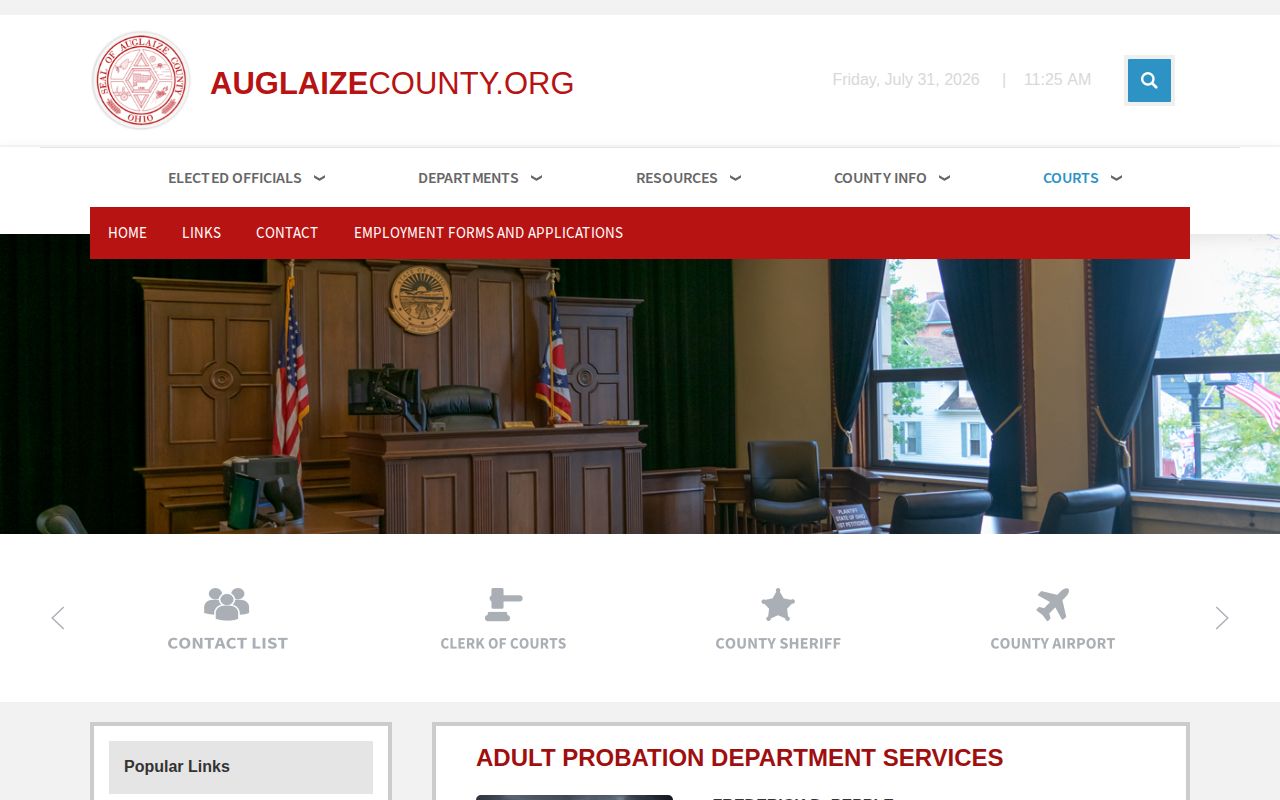
That local page is useful because it joins state APA work with the county’s own court supervision instead of treating every supervised release as the same process.
Auglaize Parole Hearing Records
For an eligible state prisoner, a future parole date is not proof of release. ODRC allows a search by Next Parole Board Hearing Date in YYYYMM form. Results are people currently scheduled for that month and year. An individual record may show the next hearing or review month and the latest hearing or review type and result.
A future date is reviewed roughly two months beforehand so a decision can be made. A past date identifies the latest hearing. Published result examples include “PAROLED” and “CONTINUED,” but those samples are not a full list of possible outcomes. Release can be authorized, denied, continued, deferred, or later rescinded under the relevant process.
Official Parole Board minutes are the authoritative public decision record under Ohio administrative rules. If the person-level result lacks the needed detail, request the applicable minutes through ODRC Central Records. Even a paroled result or a POA date, meaning parole on or after, does not prove the physical release was processed. Confirm the ODRC status and supervision start.
Hearing records also answer a narrower question than supervision records. They document review and decision activity for an eligible prison sentence. They do not establish local community control, and they do not replace the Auglaize court docket. When a hearing result and current status seem inconsistent, compare their dates first. A decision may precede release processing, or a later action may have changed the outcome. ODRC Central Records is the proper route when the online chronology does not resolve that gap.
Auglaize Supervision Violations and VAL
Supervision rules are set by the authority and case. A suspected violation can lead to review, a court filing, revocation, return to custody, or another action. The public record may lag that process. That is why a status label should be read as a clue to the responsible agency, not as a complete account of events.
ODRC uses VAL for Violators at Large. The public VAL listing reflects an alleged supervision violation. It is not operational warrant confirmation. ODRC warns the public not to approach anyone shown there, and law enforcement must separately confirm a warrant through LEADS or NCIC. For an urgent safety concern, use local law enforcement rather than trying to verify the person in the field.
Ohio VINE may send certain custody and supervision events, including revocation or return and release from parole. It is an alert layer, not a lasting case archive. A transfer is a movement between custodians, not a community release. For a durable answer, compare the ODRC record, the court docket when relevant, and the office that supervises the case.
Auglaize Release Recovery Connections
Adult Probation identifies the Auglaize County Recovery Program and cooperation among the Sheriff and jail, prosecutor, local hospital, and mental-health and addiction providers. This county-specific network can matter when a person leaves custody under supervision and must report, attend treatment, or follow a court plan. It does not mean every released person is enrolled.
A federal National Institute of Justice profile also records the historical Auglaize County Transition case-management program. Historical evidence should not be read as proof that intake remains open now. Confirm current programs, eligibility, and referral steps with Adult Probation or the agency named in the current court order.
Supervision and services serve different roles. An ODRC or CourtView record can establish the legal status. A local program may help carry out parts of a supervision plan. Neither source should be used to infer private treatment details, and a general program description does not establish that a named person participates.
Who Auglaize Probation May Supervise
The local office’s published reach is a distinctive part of Auglaize County parole and probation. It includes local community-control cases, parole, post-release control, transfers from other Ohio counties, and interstate cases whose supervised residents live in Auglaize County. Thus, a local office contact does not prove the person was convicted or incarcerated in this county.
Use Residential County in ODRC when residence is the key fact. Use County of Commitment when the Auglaize sentence is the key fact. Then inspect the actual record instead of relying on the result list. Addresses can lag, and a supervision duty may relate to an earlier offense. Same-name matches need careful review.
How Auglaize Supervision Ends
Release from a jail or prison and discharge from supervision are separate events. An ODRC record may first move from Incarcerated to APA Supervision. Later, a supervision release event or agency record may show that APA control ended. For community control, the court entry is the stronger source for completion, termination, extension, or another order.
Do not infer discharge from silence. A person may move offices, have an address update pending, or remain tied to a case that began elsewhere. VINE can report release from parole when the event is covered and registration was active, but Ohio publishes no permanent released-result window for VINE. Save the event notice if received, then verify through the originating agency.
Ohio public-record law begins with ORC 149.43, subject to exemptions and redactions. Request an existing public status or order rather than asking an office to create a narrative. ODRC warns that sentence information may not be complete and that a supervision obligation can relate to an earlier offense. Final confirmation should come from the agency or court that created the record.