
Auglaize Projected Versus Actual Release
A projected date is a forecast based on the record as it stands. An actual release is an event. ODRC labels its main field Expected Release Date/Parole Eligibility Date and also defines POA/PRD. POA means “parole on or after.” PRD means “Projected Release Date.” Either can involve a sentence calculation or parole review rather than a firm departure date.
A person held before trial at the Auglaize County Correctional Center usually has no computed prison release date. Bond information may appear, but it does not prove payment or release. The court can change bond, resolve the case, issue a new order, or impose a sentence. A sentenced county-jail term may be calculated locally. A state-prison sentence moves into ODRC’s system.
“Not in this jail” is also too broad. The person may have returned to the community, gone to court, entered ODRC, or transferred to another authority. A release date must be read with the status and the agency that produced it.
Find Auglaize Projected Release Dates
Choose the search path by custody type. The county portal is a booking and custody record for the local jail. ODRC covers people in Ohio prisons, under departmental supervision, or judicially released. It does not serve as the Auglaize jail archive. A person appears there only when a state-corrections relationship exists.
- Identify the current or last known custodian. Check the Auglaize archive for a local booking and the court docket for the case path.
- For state custody, open the ODRC Offender Search. Search by name or offender number with minimal filters.
- For an Auglaize sentence, try County of Commitment=Auglaize. Do not confuse it with Residential County.
- Open the matching record and read status, sentence information, Expected Release Date/Parole Eligibility Date, and release or supervision detail together.
- For a county sentence, use the sentencing entry and ask the jail or court for the specific computation.
The official Auglaize County release-record guide covers the archive, court, and records-request chain in more depth. Verify identity before relying on a result. Same names occur, and too many filters can hide the right ODRC match.
ODRC Auglaize Release Date Fields
ODRC’s definitions separate fields that can look alike. The Expected Release Date/Parole Eligibility Date is the broad public label. POA/PRD is its defined shorthand. Earliest Possible Transfer Date concerns transitional control, while TC/TT Sentence Expiration is a projected halfway-house date. Neither should be relabeled as a confirmed community release.
| Field or status | What it means |
|---|---|
| Expected Release Date/Parole Eligibility Date | A projected sentence end or date tied to parole consideration |
| POA/PRD | Parole on or after, or projected release date |
| Earliest Possible Transfer Date | A transitional-control timing field, not final release proof |
| TC/TT Sentence Expiration | A projected halfway-house date |
| APA Supervision | Released from prison under departmental supervision |
| Released | ODRC status indicating release, subject to record context |
ODRC warns that sentence information may not be complete. A supervision obligation may relate to an earlier offense. Questions can be sent to ODRC, Attn: Central Records, P.O. Box 430, Columbus, OH 43216. That source is stronger than trying to calculate a date from a news item or sentence length.
The ODRC definitions page shows these date and status terms. Its captured view appears below.
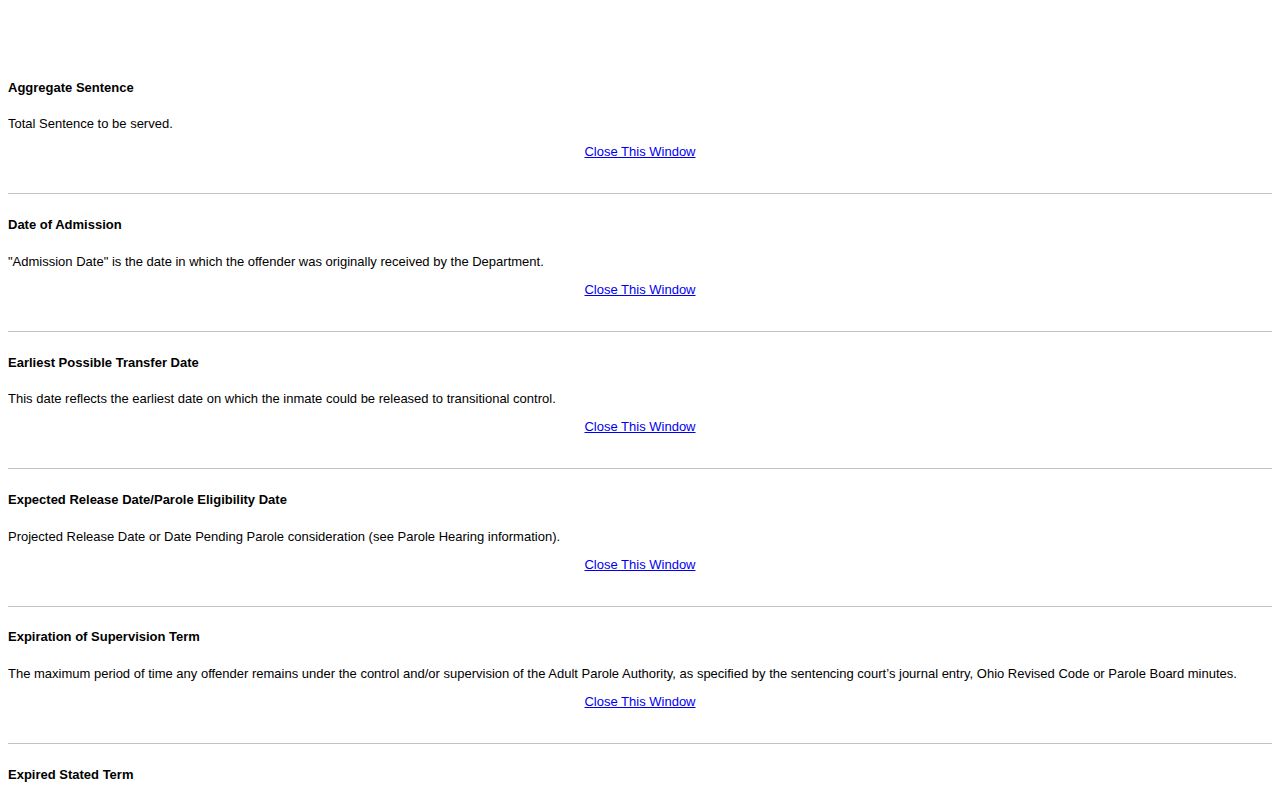
The image reinforces why each label needs its official definition before a future date is treated as an answer.
Ohio Credit and Auglaize Release Dates
Ohio’s current earned-credit framework is found in ORC 2967.194 for qualifying confinement on or after April 4, 2024. Eligible prisoners may provisionally earn one or five days for each completed month of productive participation in approved programming. Successful completion of a second qualifying activity can add up to five days. Certain milestones can yield 90 days or ten percent of the stated term, whichever is less.
Except for the milestone category, the combined participation and completion credit is capped at 15 percent of the stated term. Credit can be denied or withdrawn after rule violations and becomes final after administrative review. Mandatory or nonreducible terms are excluded. Specified serious sentences, including listed murder, aggravated-murder, life-without-parole, and sex sentences, also face exclusions.
ORC 2967.193 governs an earlier framework. OAC 5120-2-06 implements earned credit, and OAC 5120-2-03.2 addresses sentence-calculation eras. ORC 2967.191 governs jail-time credit, which is time credited for qualifying confinement before the prison sentence is calculated.
Which framework applies can depend on the dates and type of confinement. A public ODRC page may show the calculated result without exposing each internal step. That is normal. Use the displayed date as the agency’s current projection, then direct a calculation question to Central Records. The statute describes eligibility and limits, but it is not a safe worksheet for a named person. Sentencing entries, credit awards, mandatory portions, and later reviews must all be reconciled by the agency.
Ohio does not have a universal “serve 85 percent” rule. The ordinary 15 percent cap may resemble an 85 percent floor for one subset of cases, but milestone credit, exclusions, jail credit, mandatory time, consecutive terms, judicial release, transitional control, parole-era sentences, and indefinite first- or second-degree felony sentences make that shortcut unreliable.
Why Auglaize Release Dates Change
A projected date reflects many inputs, not just the term printed in one docket entry. ODRC can revise a calculation when credits, sentence terms, court action, or departmental decisions change. A county calculation can also change when a court enters a new order or credits qualifying jail time. No public user should promise a date by doing simple subtraction.
| Factor | Possible effect |
|---|---|
| Jail-time credit | Credits qualifying prior confinement under the governing order and statute |
| Earned credit | May reduce eligible ODRC time after program participation or completion |
| Discipline | Can cause provisional credit to be denied or withdrawn |
| Consecutive or mandatory terms | Can extend the calculation and restrict reductions |
| Court action | May alter the sentence, credit, judicial-release posture, or custody order |
| Parole Board action | Can authorize, continue, deny, defer, or rescind a parole-related date |
| Detainer or hold | May send the person to another authority rather than into the community |
| Calculation correction | Updates an error or newly received sentencing information |
An ODRC date change does not itself explain which factor applied. Read the sentence and release detail, then ask Central Records when the public entry remains unclear. For a local term, ask the court or correctional center rather than importing ODRC program-credit rules.
Auglaize Jail Release Date Calculations
The official Auglaize County inmate portal does not expose a sentence calculation. Its archive may show Booking Date, Release Date, and InCustody=N after the local record closes. Those fields help confirm what happened in county custody. They do not show every credit, court instruction, or later custodian.
Use the sentencing entry in Common Pleas CourtView to identify the term and any stated credit. Then ask the Auglaize County Correctional Center or the court about the actual local computation. The correctional center is at 1051 Dearbaugh Avenue, Wapakoneta, OH 45895, and its published phone is 419-739-6575. Its official facility page confirms that contact. Do not apply ODRC earned-credit rates to a county-jail sentence unless the official local record or governing authority does so.
A pretrial record calls for even more care. Bond type and amount can appear beside a charge, but the entry does not prove bond was posted. A court hearing, dismissal, recognizance order, transfer, or other event may control the next step. CourtView supplies the lasting case disposition; the sheriff record supplies the county custody event.
The county archive can be used after the event to compare the Release Date with InCustody=N. That pair confirms the Auglaize jail record ended at the shown time, not that every hold ended. If the court docket shows a prison commitment, continue in ODRC. If another county or federal authority assumed custody, use that authority’s record. This agency-by-agency check prevents a local release timestamp from being mistaken for freedom from all custody.
Keep the source dates with any notes you save. A later court entry or agency update can supersede an earlier estimate, and the newest official record should control.
Parole Dates in Auglaize Records
Parole eligibility is separate from earned credit. ORC 2967.13 includes rules for life sentences, such as eligibility after a court-imposed minimum for murder and statutory periods for several sentence forms. Some life-without-parole and other listed terms are ineligible. The sentencing entry and statute must be read together.
ODRC lets users filter by Next Parole Board Hearing Date in YYYYMM form. An individual record may also show the latest hearing type and result. Under OAC 5120:1-1-10, the Board may set a later hearing or a projected release date after a denial. That PRD creates no entitlement and can be rescinded.
Official Parole Board minutes record decisions. If the search result says “PAROLED,” still confirm the later status and supervision start. If it says “CONTINUED,” review the next date rather than treating the old one as a missed release. Auglaize residents released under APA can be routed through ODRC and the local Adult Probation contact path.
Confirm an Auglaize Actual Release
Confirmation should match the custodian. For the Auglaize County Correctional Center, use the archive release timestamp, court disposition, or a sheriff record. For ODRC, use a Released or APA Supervision status, supervision start, release detail, or Central Records response. For a transfer, follow the next agency instead of calling it a community release.
Ohio VINE can provide custody-event alerts when registration occurs while the person is in custody. County events include General Release and Transfer. Those are not synonyms. ODRC events can include General Release, transfer, revocation or return, and release from parole. VINE is free and anonymous, but it is not a durable historical archive and Ohio publishes no released-result retention window.
The Auglaize VINELink check instructions explain registration and event labels. An alert should still be checked against the record-owning office. If the projected date passes with no status change, do not assume release or error. Court action, a hold, a calculation update, or processing lag may explain the difference.